
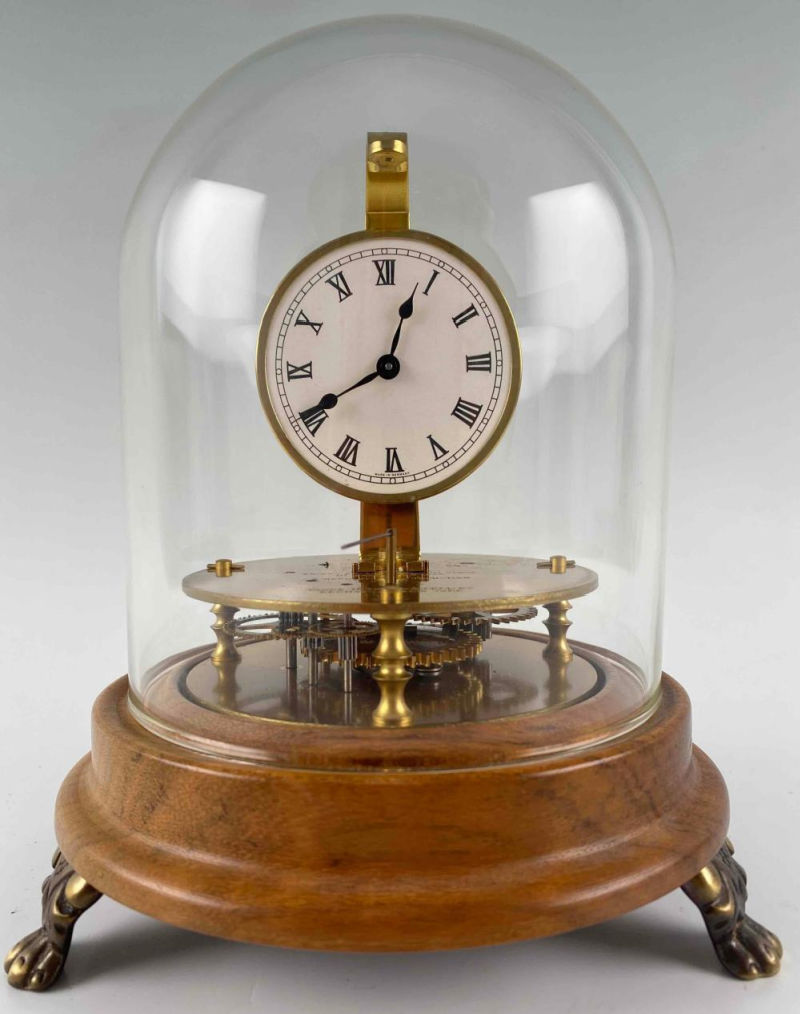
The Briggs Rotary Pendulum Clock
John C. Briggs of New Hampshire, received the first United States patent for the “application of the conical pendulum to timekeepers,” on August 21, 1855 and received a second patent, for a “mode of regulating the conical pendulum for timekeepers,” on July 15, 1856. While it is reported that clockmaker, Abiel Chandler made an attempt at developing the “Briggs Clock” in 1858 and 1859, there are no known surviving clock or designs, and in any event, the historic record indicates the clocks did not function reliably.
Sometime between 1870-1880, E. N. Welch Manufacturing Company had produced two models of a clock named, “Rotary,” a clock using the rotary pendulum. However, there is no evidence that John C. Briggs had involvement in this endeavor. Additionally, it seems the name “The Briggs Rotary” was only first used by Jesse Coleman in an August 1946 article in The American Horologist and Jeweler.
It is clear that the formal title “The Briggs Rotary Pendulum Clock” came into use with the reproduction of a clock using a rotary pendulum by the Horolovar company. Details of this reproduction from a NAWCC Bulletin article by Charles Terwilliger follows1:
The Briggs Rotary Pendulum Clock, the Horolovar reproduction of E. N. Welch’s Model II, is made by a precision time recorder factory in Germany. Its movement has such features as a nickel-steel mainspring 17 feet long, solid pinions with highly polished leaves and an 8-arbor wheel train with a gear ratio of 1:96,000. The spindle arm is a thin, straight steel rod. No hook or slot is needed to control the arc of the pendulum; the tremendous power of the heavy 8-day mainspring is balanced by friction from the wheel train, maintaining the speed of the spindle at a rate that keeps the pendulum within its prescribed limits. The motion is steady and, even with the movement’s unusually high gear ratio, the clock’s timekeeping is excellent.
Video of the The Briggs Rotary Pendulum Clock
from the editor’s collection
Reference
1. John C. Briggs and Rotary Pendulum Clocks by Charles Terwilliger, NAWCC Bulletin April 1978 Volume 20, issue 193, pg 99
members of the NAWCC can view the full article.
 HeroesofHorology.com