
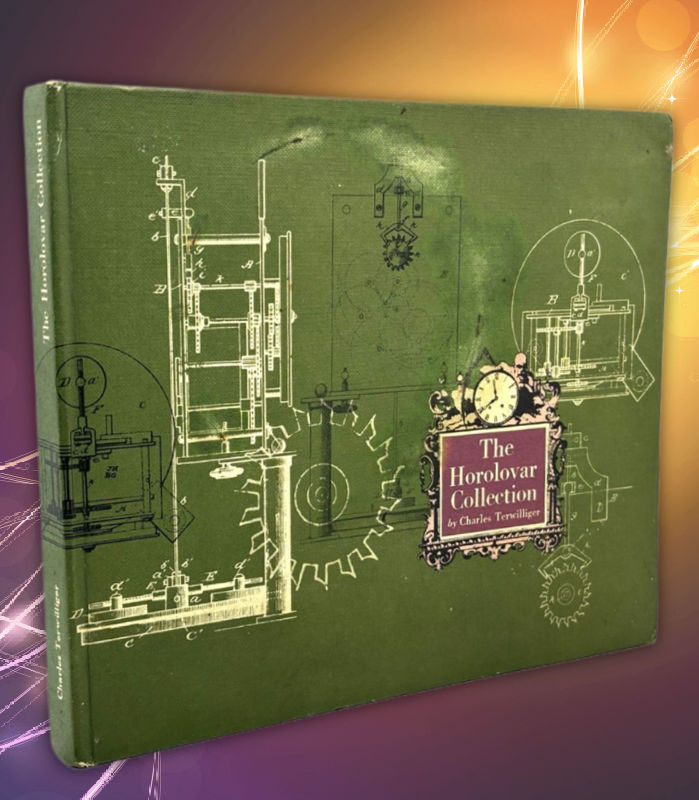
The Horolovar Collection
A comprehensive history and catalogue of 400-day clocks (1880-1912)
1962 – Limited Edition
Author: Charles Terwilliger
Description: A Comprehensive History and Catalogue of 400-Day Clocks (1880-1912). Picture Collection of 52 rare 400-Day clocks. This is a limited edition of 1000 copies. A “must-have” for any serious 400-Day Clock collector.
A limited edition of 1,000, numbered copies, size 7½” x 9″, 144 pages, hard cover, over 250 illustrations.
Published by The Horolovar Company, Box 299, Bronxville, New York
Review by H. Fried • Book History by Mun Chor Weng • A Video Review
REVIEW BY HENRY B. FRIED:
Most of us think of the 400-Day Clock as a simple but attractive table clock, distinctive because of its rotating pendulum and covering glass dome. That this clock had an interesting historical background, and a variety of early models to illustrate its development, is not generally known. However, Charles Terwilliger, a name synonomous with the 400-Day Clock, has, as expected, gathered a collection of early 400-Day Clocks — now housed at the Columbia Museum of Antiquities, Columbia, Pennsylvania—and, since it is impossible for everyone to visit this museum, Mr. Terwilliger has brought a well-documented description of the collection to them in this book.
Knowledge of the variety and novelty of this collection is undoubtedly of interest to collectors of other types of clocks, but the book is not only of interest to the collector; its text and profuse illustrations will also be welcomed by dealers, dabblers, and those who like unusual clocks and desire to know their age, history and status in the world of antiquity, rarity and desirability. This book, like Mr, Terwilliger’s other books, is complete and well organized.
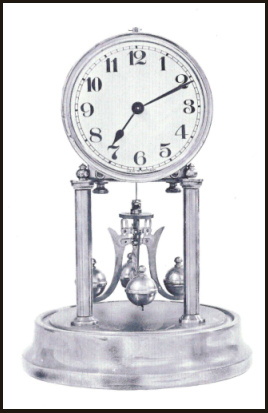
Many different models of 400-Day Clocks (including one made in France), 400-Day Clocks with unusual escapements, 400-Day Clocks with full striking mechanisms, and a rare mystery clock of beautiful design are among the many interesting torsion pendulum clocks described and illustrated in this book. Included, also, are historical data on the origin of 400-Day Clocks, practical hints on their repair, reproductions of early 400-Day Clock advertisements and patent drawings, and a discussion of the technical advancements made in these clocks from the original patent to today. In an eye-catching adjunct to the book’s 24-page appendix are copies of patents for altering the design of the pendulum to compensate mechanically for the timekeeping errors caused by changes of temperature.
Historical facts about the two American torsion pendulum clock inventors, Aaron D. Crane and Samuel B. Terry, are not overlooked, but whereas the author acknowledges that both of these men obtained patents on torsion pendulum clocks before 1880, he does not classify their clocks as true “400-Day.” Mr. Terwilliger champions the 400-Day Clock’s ability to keep good time and defends it against critics who claim that it is decorative rather than practical. He reminds his reader that owners of one-day and eight-day clocks often give the minute hand a tolerant, corrective nudge at each winding. But the 400-Day Clock accumulates these minute digressions, and it is the accumulated error over a period of weeks or months which is cited unjustly by biased critics.
In all, this book not only completely documents the story of the 400-Day Clock, but it also makes a worthy addition to the horologist collector’s library.

A History of the Horolovar Collection
by Mun Chor Weng
The Horolovar Collection, a Comprehensive History and Catalogue of 400-DAY CLOCKS (1880-1912 ) [henceforth called The Horolovar Collection or HC Book] written by Charles Terwilliger was published in 1962. Since then nothing has been written about the book or about the famous 400-Day clock collection featured in the book. In researching for materials to write an article on this topic this writer had approached Bob Terwilliger, son of Charles for assistance and information about the events that led his father to write the book as well as the reason for assembling the Horolovar Collection. In this respect Bob has been most helpful and he has written an insightful write–up which with his permission is featured in the Introduction of this article. This writer owes Bob Terwilliger a debt of gratitude for his contribution. Bob writes:
“While collecting clocks for determining the spring strength to associate with the backplate drawing in the Repair Guide Charles Terwilliger also acquired a number of unusual or exquisite examples of torsion pendulum clocks. The post WW II clocks came largely from the Post Office auctions, most of the finer clocks were purchased at one of the New York auction houses where he had some distinct advantages. 400-Day and other torsion pendulum clocks were not yet popular with collectors and many of the other bidders had very little idea what these clocks were supposed to look like.
By the early 60’s The Horolovar Company was stable and successful. The Horolovar Guide was in its 4th edition and Horolovar springs had become the standard for repairmen. Spring sales were now mostly through wholesalers and wholesale distributors.
Terwilliger now had the time to write a book which probably been anticipating. The book would catalog his collection of better clocks to share with other collectors. The 400-day clock had arrived on the collectibles scene largely due to the Horolovar Guide.
We have to keep in mind that his entire operation, including the Horolovar Company and its employees were all still occupying the basement of his home in Bronxville.
Preparing the book took some time. A temporary photo studio was set up on weekends and the clocks were either brought from a local warehouse or down from the living quarters upstairs. While the book was in preparation, Terwilliger had some discussions with Earl Strickler who was a very early member of the NAWCC. He lived in Columbia PA where he operated a small museum in the basement of his home which he called “The Columbia Museum of Antiquities”. The two made what was to be a win-win arrangement. After the clocks had been photographed and described they were to be sent to Columbia where Earl would be happy to have them for display in his museum. At the same time Terwilliger would have a secure place to store them.
An additional benefit of this arrangement is that by the time the book and Henry Fried’s review were published the clocks were in fact “on loan to the Columbia Museum of Antiquities” Columbia Pennsylvania, Earl T. Strickler, Curator. Thus adding a note of prestige to the collection ”.
~ Robert Terwilliger
What makes a 400 day clock a Horolovar Collection piece?
As stated in the Forward of The Horolovar Collection, each of the clocks in the Horolovar Collection was selected for some unusual features in design of movement, escapement, and pendulum or case design. Some examples included:
- Full table strikers by De Gruyter, R Schnekenburger striker with rare detent escapement
- Light house clocks, a huge 28.5 inch ‘Mysterious’ torsion Pendulum clock
- Miniatures and other clocks with rare torsion pendulums
Little information is available about the Horolovar Collection when it was displayed at the museum (e.g. number of visitors and duration of the collection’s display).
The Horolovar Collection catalogued his clock collection would form the only known historic reference to a very significant clock collection. It was produced by The Horolovar Company in 1962. In addition to pictures and detailed information of each of the 52 clocks in the collection, the book contains information relating to:
- History of the 400-day clock
- History of Striking 400-day Clocks
- Myths and Facts about 400-day Clock Repair
- The problems of temperature change and timekeeping
- Notes on suspension saddle
- Milestones in the post World War II sale.
- Appendix listing patent drawings, early 400-day clock advertisements, as well as instructions how to set going and to regulate 400-day clocks.
Thus the Horolovar Collection was an important and significant horological publication during its time as it contained much unpublished information relating to 400-Day clocks together with pictures and descriptions of a collection of rare 400-Day clocks. With the publication of this book, the general public was for the first time introduced to these fascinating clocks. Much of the contents of this book including pictures of many Horolovar Collection clocks were incorporated into subsequent editions of the Repair Guide which is regarded as a ‘ Bible’ by clock repairers as well as 400-day-Day clock collectors. Only 1000 numbered-copies of this catalogue, each selling for US $10 were printed in 1962. They have long since been sold out and are now greatly sought after by collectors.
 HeroesofHorology.com